
SUSTAINABILITY AND environmental product declaration
Sustainability
The drive for more environmentally-conscience and climate-friendly construction practices has continued to gain momentum in the United States. Programs like Leadership in Energy and Environmental Design (LEED) certification developed by the U.S. Green Building Council began in 2000 and continue to expand today. Projects earn credits for various categories including recycled material usage on their way to achieving certification up to Platinum level status with the overall mission of addressing climate change, meeting Environmental, Social and Governance (ESG) goals, enhancing resilience and supporting more equitable communities. More recently, international focus has expanded to consider the importance of a Circular Economy. A Circular Economy keeps materials and products in circulation for as long as possible. A circular economy reduces material use, redesigns materials and products to be less resource intensive, and recaptures “waste” as a resource to manufacture new materials and products.
While many foundation systems struggle to contribute to the multiple parts of the circle or sustainable construction efforts, Tiroler Rohre, GmbH (TRM) recognizes sustainability and the circular economy as driving principles for the manufacturing of Ductile Iron Piles.
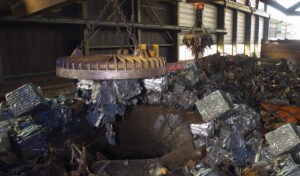
- Manufacturing of TRM’s Ductile Iron Piles utilizes 100% recycled materials as raw product, providing a more sustainable solution than many deep foundations, and starting off the circular economy by contributing to the waste management component from previous metal products.
- Heat as a manufacturing byproduct supplies 650 households through a regional district heating network, saving 3,100 tons of carbon emissions annually.
- TRM’s plant operates the largest photovoltaic system in Tyrol, Austria to generate energy that supplies 300 households.
- Sophisticated filter technologies at the plant provide a state-of-the-art control mechanism to prevent release of harmful air and wastewater exhaust into the environment.
- Raw materials are transported by rail to limit greenhouse gas production from diesel trucks.
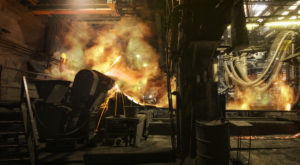
TRM is so committed to environmental practices and impacts, they were the first cast iron manufacturer to initiate and receive an Environmental Product Declaration. An Environmental Product Declaration, or EPD, provides an evaluation of the environmental impact through the life cycle of a particular product so that it can be compared with other products performing similar functions. As standardized process through ISO 14025, EPDs allow project stakeholders the ability to make decisions based on an independent environmental assessment of products. TRM was awarded the Environmental Product Declaration for the Ductile Iron Pile system by Bau EPD in 2022. The EPD includes a detailed breakdown of the Global Warming Potential or carbon footprint of Ductile Iron Piles and shows the positive contributions the system provides compared with other systems.
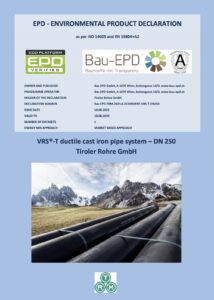
For more information about the sustainability of the TRM Ductile Iron Piling system, check out the Sustainability Brochure. If you are involved in a project where sustainable foundations are valued by the project stakeholders, reach out to us to see how a Fast. Simple. Safe.® and Sustainable solution can work on your job.