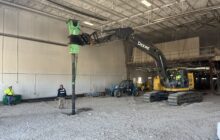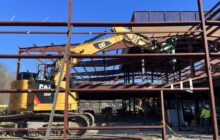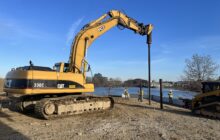

Ductile Iron Piles provided a low overhead, cost-effective foundation solution to support the heavy column loads and transfer loads below the deep soft clay and organic/peat soil.
Project Description:
As part of the future tenant build-out, new mezzanine construction was planned inside an existing 150,000 square foot warehouse building shell in Caledonia, Michigan. The building shell was supported on augercast piles due to the presence of deep deposits of soft clay and organic soils. Mezzanine construction also required deep foundation support for nearly 140 interior columns. Column loads for the new mezzanine range from 100 kips to 250 kips. The existing warehouse shell had interior building heights ranging from 25 to 28 feet.
Geotechnical Conditions:
Subsurface conditions at the site generally consist of clay (glacial till), which extends to depths of at least 60 feet. The clay layer is soft to firm in the upper 17 feet and becomes stiff to very stiff with increasing depth. Organic soils and peat impacted about 70% of the building area, extending as deep as 18 feet below planned finish floor elevations. In addition, pockets of loose to medium dense sand are present in the glacial till at varying depths between 4 and 24 feet. Perched groundwater was encountered at depths ranging from 3 to 17 feet in the borings.
Project Challenges:
Provide a low overhead, cost-effective foundation solution to support the heavy column loads and transfer loads below the deep soft clay and organic/peat soil.
Advantages
- Low-headroom installation of 50 to 60 ft piles
- Simple, low-vibration installation
- Small diameter, high-capacity load resistance
- Rapid turn-key installation
Design and Construction Solution
The combination of the heavy column loads, soft clay, deep organic/peat soils, and restricted overhead clearances posed significant challenges to the project team. The geotechnical engineer considered a variety of deep foundation options that would address the project’s unique challenges. Specifically, low-headroom Ductile Iron Piles (DIPs) and helical piles were considered. The DIP solution was chosen to reduce uncertainties and risks associated with helical installations and performance. The exterior grouted DIP solution could be installed with limited overhead clearance, would by-pass the organic soils and soft clay and could develop high friction through grout-to-ground bonding and end-bearing capacity in the deeper, stronger glacial clay.
Design engineers at Geopier utilized a combination of exterior-grouted Series 118/7.5 Ductile Iron Piles with 220 mm grouting shoes for compression loads of up to 75 kips and Series 170/9.0 DIPs with 270 mm grouting shoes for piles that were also subject to lateral loads of up to 5 kips per pile. Pile lengths ranging from 50 to 60 feet were required to meet the design loading conditions.
Peterson Contractors, Inc. (PCI) was the selected geotechnical contractor for the work. Due to the restricted overhead clearances, PCI utilized a CAT 330 excavator and CAT H130 percussion hammer to install the piles. A total of 483 DIPs were installed on for mezzanine foundation support. Working in collaboration with the general contractor, PCI averaged over 1,000 LF per day, with some days approaching 2,000 LF of production.

Project Team Members
DIP Installation Partner: Peterson Contractors, Inc.
Geotechnical Engineer: Soils and Structures, Inc.
General Contractor: Visser Brothers, Inc.
Structural Engineer: Clark, Richardson and Biskup Consulting Engineers