Ductile Iron Piles provided a deep foundation solution to provide settlement control and work within the access limited and height restricted areas while minimizing risks of cost and schedule overruns from the highly variable rock conditions.
Project Description:
The new Airside D Terminal at Tampa International Airport was constructed after removal of an existing concrete apron. Construction features both 2-story and 3-story terminal areas. Column loads are up to 1,805 kips.
Geotechnical Conditions:
Ground conditions consist of very loose to dense fine sand with varying amounts of silt extending 20 to 30 ft underlain by variable limestone to the boring termination depths. The limestone exhibited high penetration resistance (SPTs), which was designated as the competent bearing layer. However, rock cores exhibited strengths (UCS) of 240 to 2,470 psi and RQD values of 0 to 56 percent, reflecting the irregular weathering typical of Florida karst limestone. Groundwater was measured approximately 10 to 15 ft below grade. Complete loss of drilling fluid circulation was recorded at multiple borings, indicative of the porous nature of the limestone.
Project Challenges:
Provide a deep foundation solution to provide settlement control and work within the access limited and height restricted areas while minimizing risks of cost and schedule overruns from the highly variable rock conditions.
Advantages
- Easy site access in constrained working area
- Low vibrations near existing structures
- Adaptable pile lengths for variable bedrock elevations
- Low height equipment for active airport work
Design and Construction Solution
With the presence of loose sand layers and variable depth limestone, shallow foundations bearing on unimproved ground would not meet the project settlement criteria of 1-inch total and ½-inch differential for loads exceeding 500 kips. In addition, documented soil and groundwater contamination as well as highly variable rock depths made spoil-generating deep foundation systems such as auger cast piles or drilled shafts undesirable because of the contaminated spoil handling and disposal. The project team also identified challenges associated with grout overage risks for grouted foundation elements and the need to limit installation-induced vibrations due to the site’s proximity to active airport facilities and infrastructure.
The design team selected an approach using shallow foundations designed for 5,000 psf supported on a Rigid Inclusion (RI) ground improvement system with a load transfer platform (LTP). The RI elements needed to be installed through the sand and terminate in limestone. A granular LTP above the RI elements was planned to transfer and distribute the foundation loads to the RIs. To maintain settlement continuity across the structure, footings with lighter column loads were also supported on the RI-LTP system.
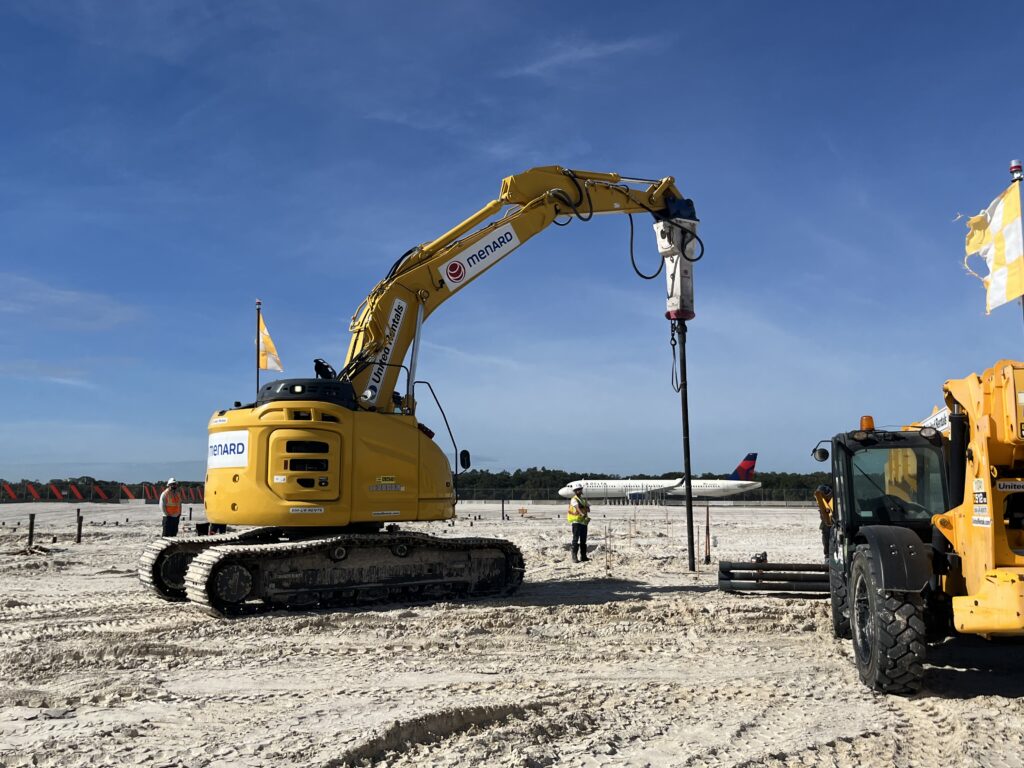
Menard USA evaluated several ground improvement alternatives and proposed Series 118/7.5 and Series 170/9.0 Ductile Iron Piles (DIPs) to serve as RIs based on cost, schedule, constructability, and risk considerations. The dry displacement installation eliminated contaminated spoils and mitigated the grout overage risk. The DIP’s modular Plug and Drive system allowed each element to be driven to a set-based refusal criterion in the variable limestone regardless of depth. Design efficiency was optimized by using Series 118/7.5 DIPs (100 kips per pile) for footings loads less than 450 kips, and Series 170/9.0 DIPs (200 kips per pile) for footing loads greater than 450 kips.Finally, the low vibration installation method using low clearance conventional excavators allowed for work on the active airfield and adjacent to existing facilities without issue. Menard was awarded the ground improvement scope.
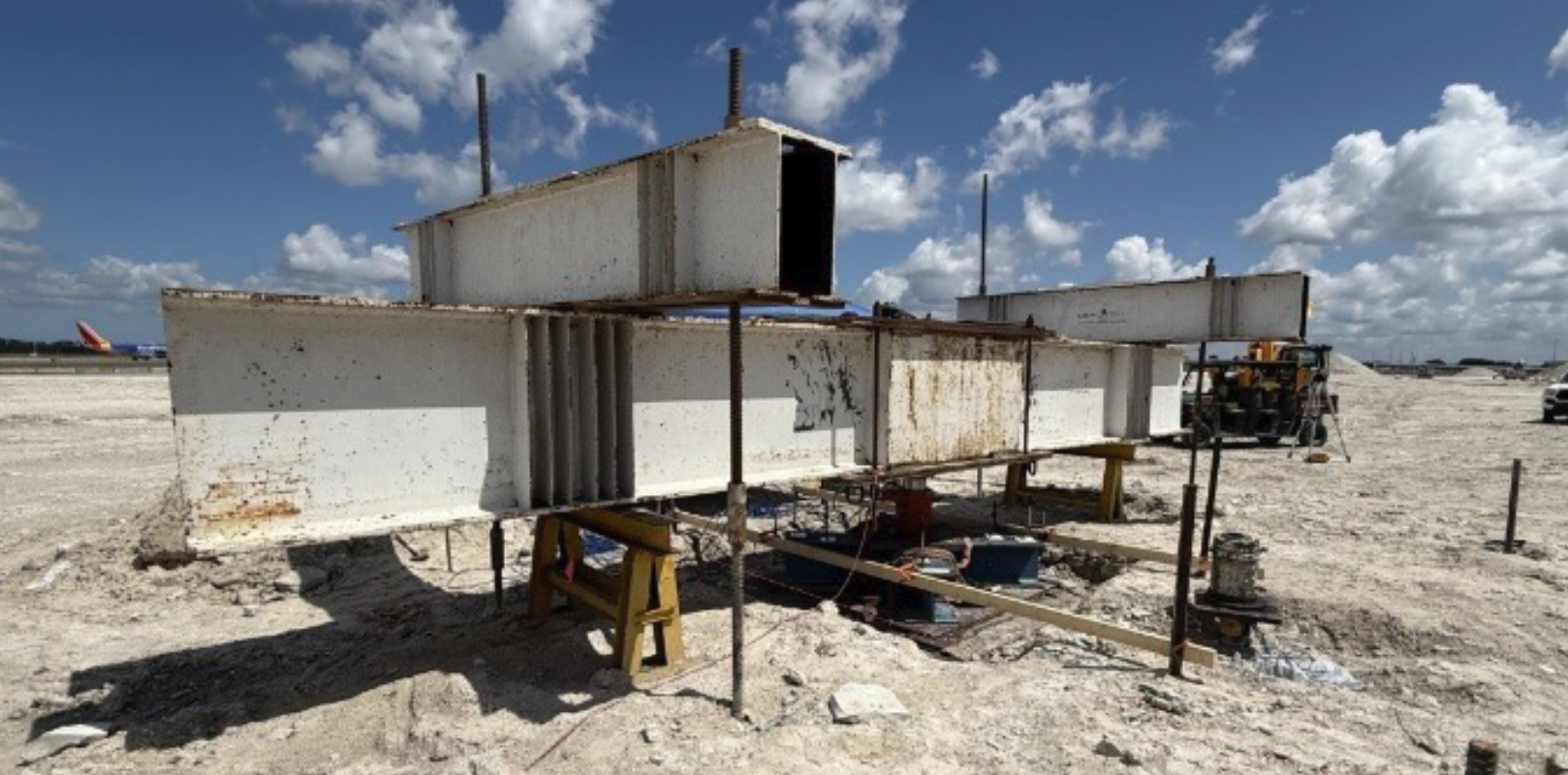 Prior to production, a full-scale load testing program was conducted, including 2 RI-LTP footing load tests and an individual RI load test. The footing load tests reproduced performance of an F6 (6’ x 6’) footing and an F8 (8’ x 8’) footing. A total of 3 and 4 DIPs were installed beneath each footing, respectively. After DIP installation, 12-inch diameter steel plates were positioned on the pile heads followed by a 6-inch dense graded aggregate LTP and then a steel reaction plate. The F8 test was loaded to 676 kips (211% of the 320-kip design load) with a deflection of 0.9 inch. The F6 test was also loaded to 676 kips (375% of the 180 kip design load) with only 0.5 inch of deflection. The system easily satisfied the acceptance basis of 5,000 psf allowable bearing with total settlement limited to 1 inch.
Following a successful load test program, Menard installed all production elements on the project. With the conventional excavators, there were no issues with FAA requirements for height restrictions of large pile rigs.
Project Team Members
DIP Design/Build Installer: Menard USA
Geotechnical Engineer: Tierra, Inc.
General Contractor: Hensel Phelps
Structural Engineer: HNTB