
Axial Load Testing of Ductile Iron Piles
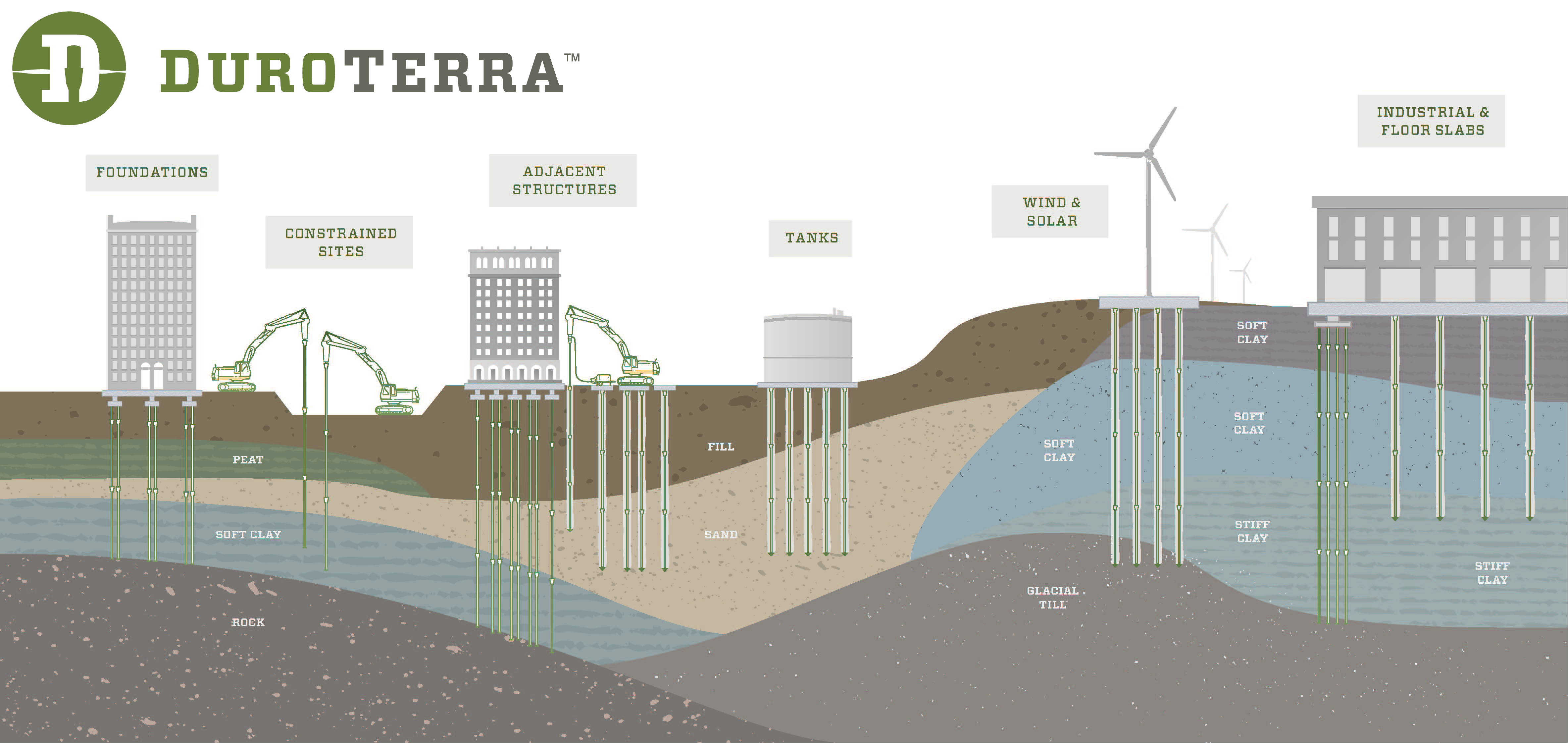
Unlike other deep foundation systems that may rely only on correlations as indicators of capacity, Ductile Iron Piles are routinely load tested to verify performance and confirm design capacities. One of the more frequent questions that arises is what type of load testing can be performed on Ductile Iron Piles (DIPs). In most cases, this innovative low-vibration driven pile is tested using traditional testing methods. But some pile-specific limitations must be considered in planning a test program. The following provides a brief summary of applicability of common test methods used with Ductile Iron Piles.
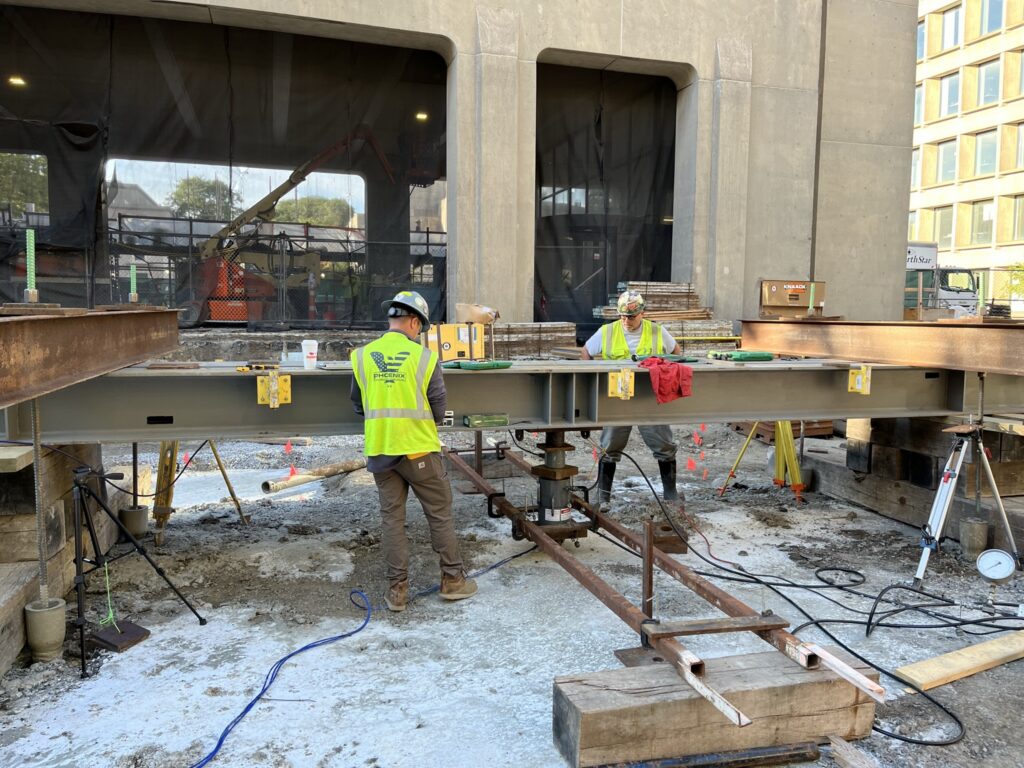
Compression Load Testing (ASTM D1143)
Traditional full-scale compression load testing using reaction piles is by far the most common type of load testing performed on DIPs. In fact, our database of experience includes hundreds of full-scale tests performed in the U.S. A non-production test pile is driven in place using the same equipment and methods anticipated for production piles. Instrumentation (telltales, strain gauges, etc) can be incorporated in the test pile for load-response interpretation. For reaction piles, exterior grouted friction DIPs are often used. For this application, center thread bars are wet-set in the DIPs and designed to carry the tensile loads. A shallow, debonded concrete thrust block can be used to minimize lateral movement of the top of the test pile and to maintain lateral stability during testing. The load test is performed up to 200% of the design load and rebounded. Compression load testing has been performed up to 500 kips on Ductile Iron Piles in the U.S.
Tension Load Testing (ASTM D3689)
Ductile Iron Pile capacities can also be verified using tension load testing. Tension testing is performed in situations where the geotechnical side friction requires verification. This is most commonly associated with testing of exterior grouted friction DIPs (i.e. grouted displacement) where the controlling performance mechanism is the geotechnical resistance along the perimeter of the pile. This is similar to micropiles installed within a soil matrix. A center threadbar is wet-set into the center of the grouted test pile. The threadbar is sized to resist the full test load along with an adequate safety factor for testing. Tests are performed up to 200% of the design load and rebounded. Depending on the application, various loading schedules may be used. Tension testing is often less involved and less expensive than compression load testing because it can eliminate reaction piles as well as thrust block requirements. However, tension testing would not be appropriate for piles generating capacity through tip resistance.
High Strain Dynamic Load Testing (ASTM D4945)
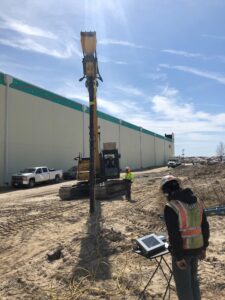 High strain dynamic testing or PDA testing is frequently used on traditional driven pile projects. While this testing procedure can be used with Ductile Iron Piles, the testing is often limited due to the high frequency, low amplitude energy associated with the percussion hammers used for installation. Specifically, these hammers operate at rates of 300 to 600 cycles/minute and the energy per single blow is insufficient to generate enough tip movement to verify the full design capacity. Instead, a separate, high energy pile hammer or drop-weight device is typically required to obtain meaningful PDA test results. While the mobilization of this additional equipment may be desirable on large projects, it may be cost-prohibitive on smaller projects, making a full-scale test more appropriate.
Besides confirming ultimate capacities, dynamic testing has been used during driving to monitor the pile installation and has provided useful learnings. In a presentation as a part of Deep Foundation Institute’s IMPACT Webinar series, Alex Ryberg, P.E. of GRL Engineers, Inc. shared observations from dynamic testing of Ductile Iron Piles, specifically related to the Plug & Drive connection. Ryberg observed that the “friction weld appears to be conclusively formed during installation.” While this finding was not unexpected, the information adds to the body of knowledge for the Ductile Iron Pile Plug & Drive connection, providing geotechnical designers with additional validating data related to this unique feature of the DIP system.
Statnamic™ Load Testing (ASTM D7383)
Developed by Applied Foundation Testing, Statnamic load testing uses the burning of special fuel within a cylinder and ram to react against a heavy mass to induce a load impulse on the test pile. The load-deflection behavior of the pile is monitored in response to the applied impulse load. Statnamic testing eliminates the need for reaction piles, hydraulic jack or standard test beam setup. While not commonly used for Ductile Iron Pile testing, this testing approach has been used on occasion for projects in Florida where mobilization of the equipment was minimal.
Summary – Load testing of Ductile Iron Piles is a critical part of the design verification process. Geotechnical contractors and project teams have a variety of options for testing, and the best option usually comes down to which method can provide the best overall value to members of the project team. While DuroTerra is not directly involved in performing the load testing of Ductile Iron Piles, our engineers can provide insight on test selection, setup and interpretation based on past experiences on a range of projects with a wide variety of geotechnical conditions and logistical constraints.
The following projects highlight applications of testing on Ductile Iron Pile projects. For more information on DIP load testing or the system in general, don’t hesitate to contact us.
PROJECT EXPERIENCE – EVERSOURCE SUBSTATION SECURITY FENCE

Construction involved a new 3,600 LF security fence and integral flood control wall surrounding an existing substation located in South Boston on Boston Harbor. The fence was designed as a retaining wall structure with a combination of axial, lateral and overturning forces due to physical impact loading, wind and flooding. Soil conditions generally consisted of up to 23 feet of highly-variable “urban” fill underlain by sand and clay estuarine deposits and very soft marine clay followed by glacial till and rock. The depths to penetrate the unsuitable soils were highly variable with the marine clay ranging in thickness from 4 to 47 feet.
A cost-saving, hybrid foundation solution was developed by Phoenix Foundation Company utilizing a combination of DIPs at many locations along with drilled micropiles in locations where obstructions (i.e. buried granite sea walls) required a drilled solution. Exterior grouted DIPs were installed using a Series 118/9.0 pile with a 270 mm diameter grout shoe to develop working capacities of 102 kips (compression). A center bar was wet-set in the pile to resist the 20 kips tension load. A 9.625-inch diameter steel casing was also installed in the upper 10 feet of the pile to provide a working lateral capacity of 18.5 kips. Extensive load testing performed across the site showed superior performance of the design with compression and lateral tests performed to 250% of the design loads and tension tests performed to 350%. Over 325 DIPs were installed to depths ranging from 42 to 120 feet with an average around 75 feet. The innovative approach provided the most cost-effective and rapid solution for challenging ground and working conditions. For more information, check out the project summary.
PROJECT EXPERIENCE – CARTI CANCER CENTER LINAC

Construction of a new Linear Accelerator (LINAC) vault at the existing medical facility required support for the heavy structure. The vault consisted of 4-ft thick concrete walls and a concrete roof supported on a mat foundation with an applied pressure of 5,000 psf. Soil conditions included fill underlain by very soft to stiff clay extending between 55 to 70 feet. Exterior grouted Ductile Iron Piles were designed for capacities of 100 kips (compression) and 15 kips (tension). A Series 118/9.0 Ductile Iron Pile were installed with a 220 mm (8.7 inch) diameter grout shoe to a depth of 44 feet. Full-scale compression load testing was performed up to 250 kips (250% of the design load) and showed less than 0.6 inches of deflection. A total of 49 piles were installed in 6 working days on the constrained site. For more information, check out the project summary.