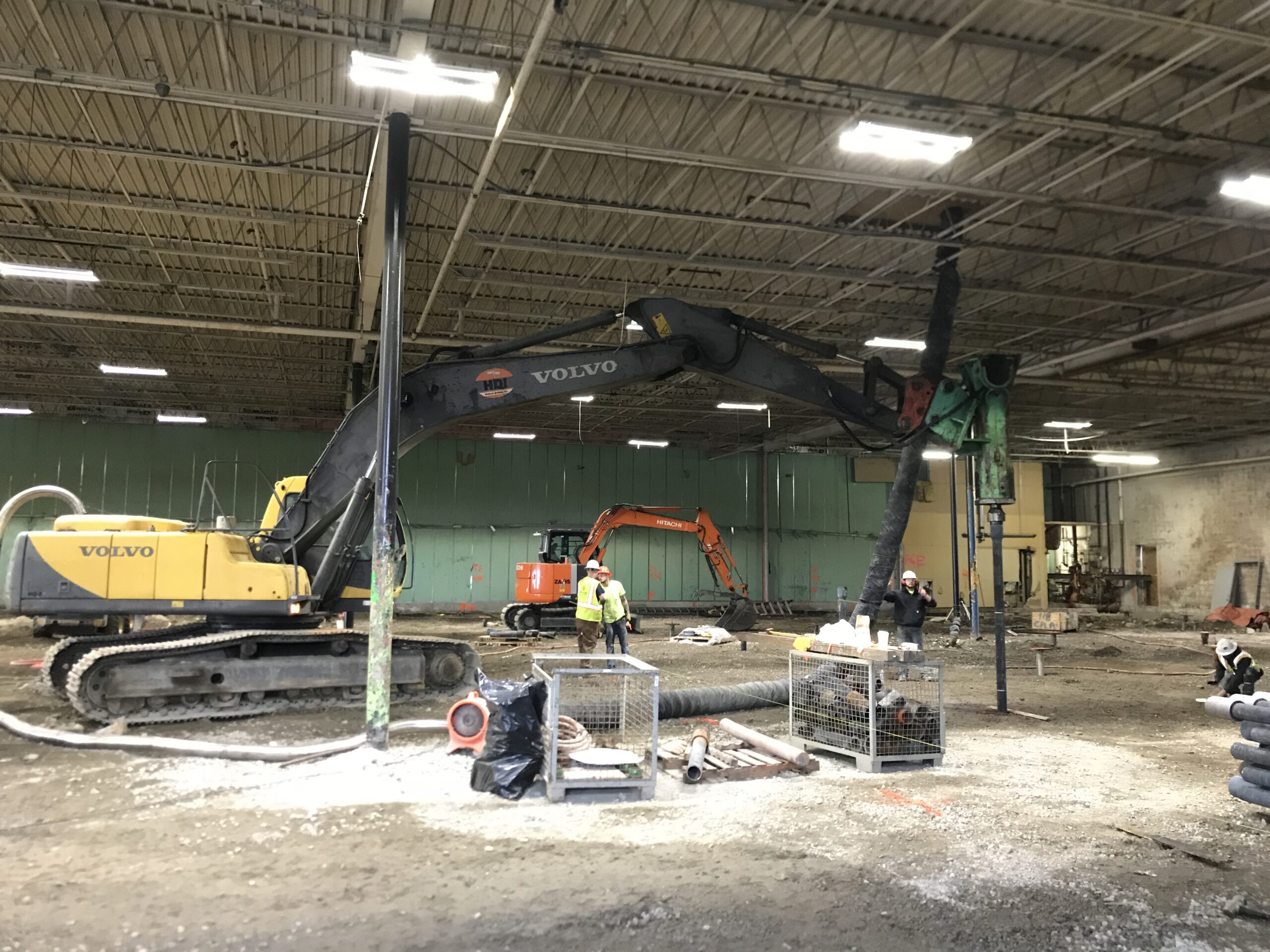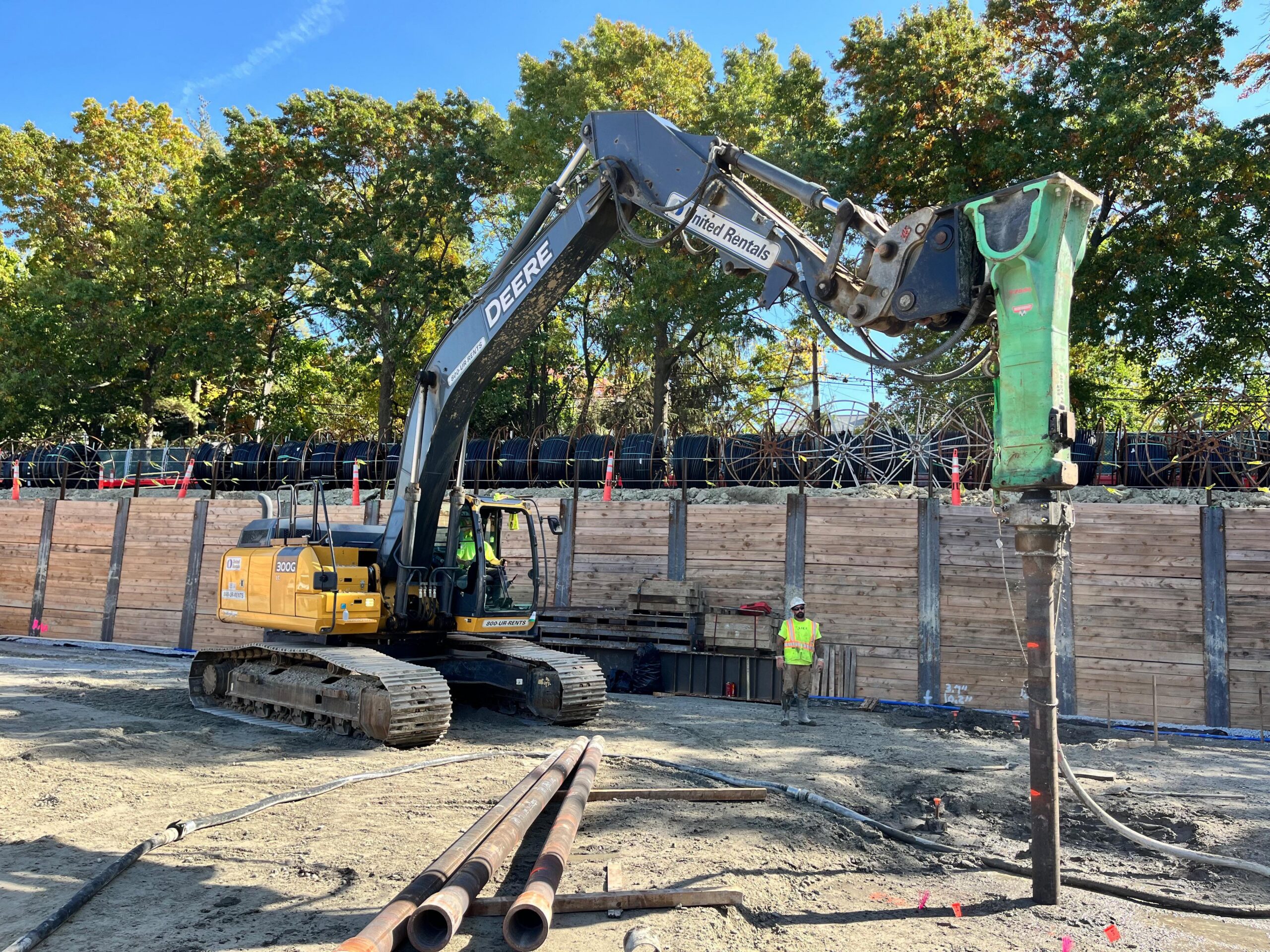
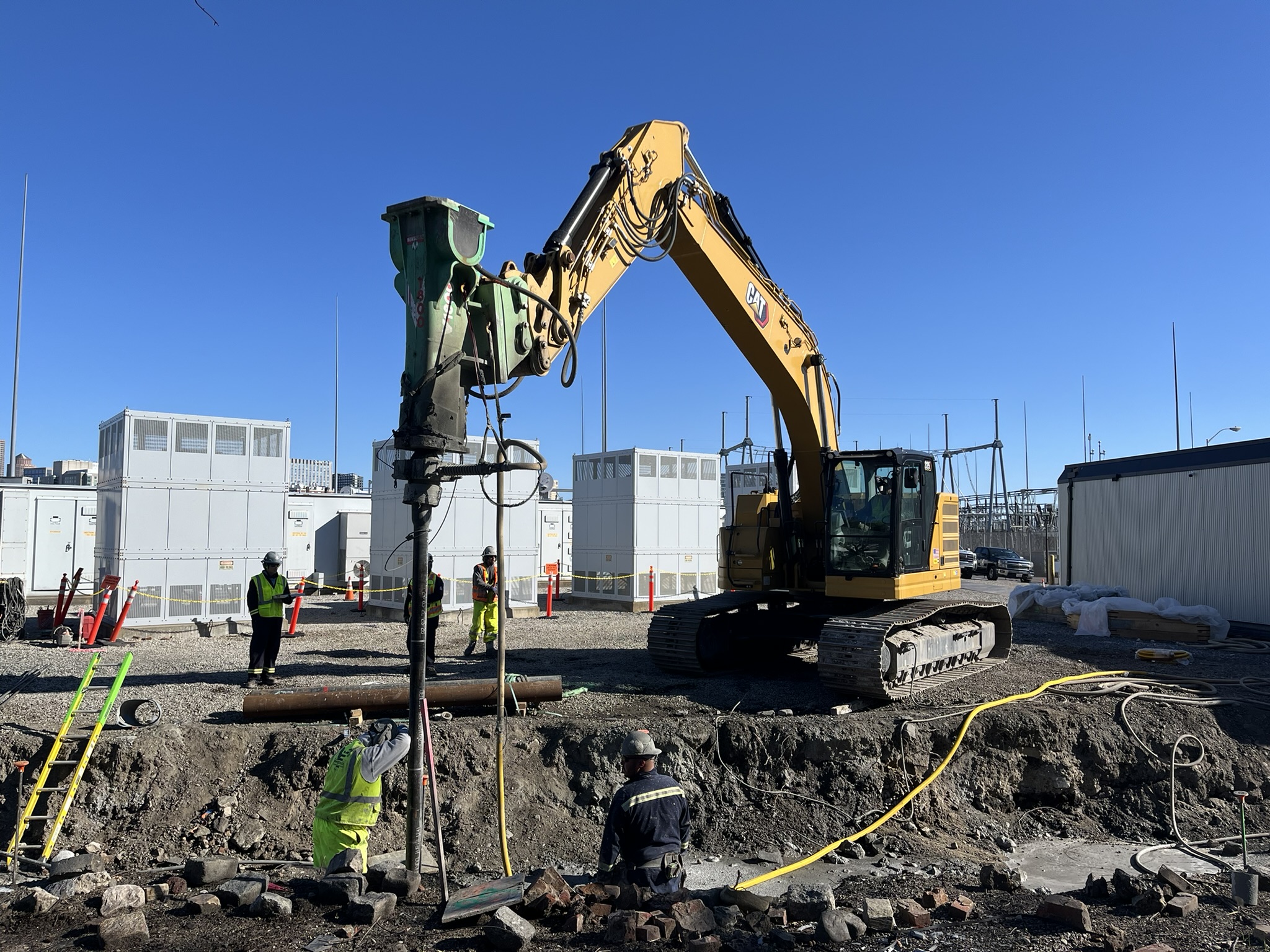
Ductile Iron Piles provided a cost-effective foundation support solution across the site to meet the loading demands while working in areas with limited access, vibration sensitivity and challenging urban fill.
Project Description:
The project involved the construction of a new perimeter security fence and integral flood control wall around an existing substation located on Boston Harbor. The fence was designed as a retaining wall structure with a combination of axial, lateral and overturning forces due to physical impact loading, wind and flooding. The planned fence alignment was over 3,600 feet in length.
Geotechnical Conditions:
Soil conditions generally consisted of 13 to 23 feet of highly-variable “urban” fill underlain by 6 to 16 feet of loose to medium dense silty sand and medium stiff clay (estuarine deposit), followed by 4 to more than 47 feet of very stiff to very soft marine clay that became softer with depth followed by medium dense to very dense granular glacial till. Rock was encountered beneath the till and ranged from depths of 60 to 76 feet where encountered in the borings. The top of till depth generally increased from the southwest to the northeast (towards the water) across the site. Groundwater ranged from 6 to 13 feet below grade.
Project Challenges:
Provide a cost-effective foundation support solution across the site to meet the loading demands while working in areas with limited access, vibration sensitivity and challenging urban fill.
Advantages
- Rapid installation compared with micropiles
- Low vibration installations
- Cost savings compared with micropiles and other systems
Design and Construction Solution
Initial plans for the project featured 685 drilled micropiles for foundation support. Plans featured pairs of micropiles spaced at distances of 8 to 16 feet on-center depending on location along the retaining wall. Pile loads were up to 102 kips (compression), 20 kips (tension) and 18.5 kips (lateral). Specifications required a 9.625-inch diameter micropile with permanent 0.545-in thick casing be installed through the urban fill to develop bonding in the marine clay, glacial till and potentially rock to develop suitable capacities.
While the risk for obstructions in the fill remained, geotechnical contractor Phoenix Foundation Company, Inc. identified the potential to provide a hybrid solution to save time and money. The solution consisted of driving low vibration Ductile Iron Piles (DIPs) in areas where fill penetration was possible and drilling micropiles in areas where access was extremely limited and/or obstructions like granite blocks from buried sea walls and other oversized obstructions prohibited the driving of piles.
The DIP design was developed to provide a 1:1 replacement of the micropiles. This provided the greatest degree of flexibility during construction to allow for either pile type to be used at each location. In order to meet the compression and tension requirements, an exterior grouted DIP solution was developed using a Series 118/9.0 Ductile Iron Pile and a #8 (Grade 75) center bar. The lateral loads were significantly higher than could be resisted by the Series 118/9.0 pile alone, so an oversized 270 mm (10.6 inch) diameter grouting shoe was used along with a 10-ft long, 9.625-inch diameter steel casing wet-set into the exterior grout. The combination of the exterior grouted Series 118/9.0 pile, 0.472-inch thick steel casing, and #8 center bar provided sufficient resistance to meet the compression, tension and lateral resistance.
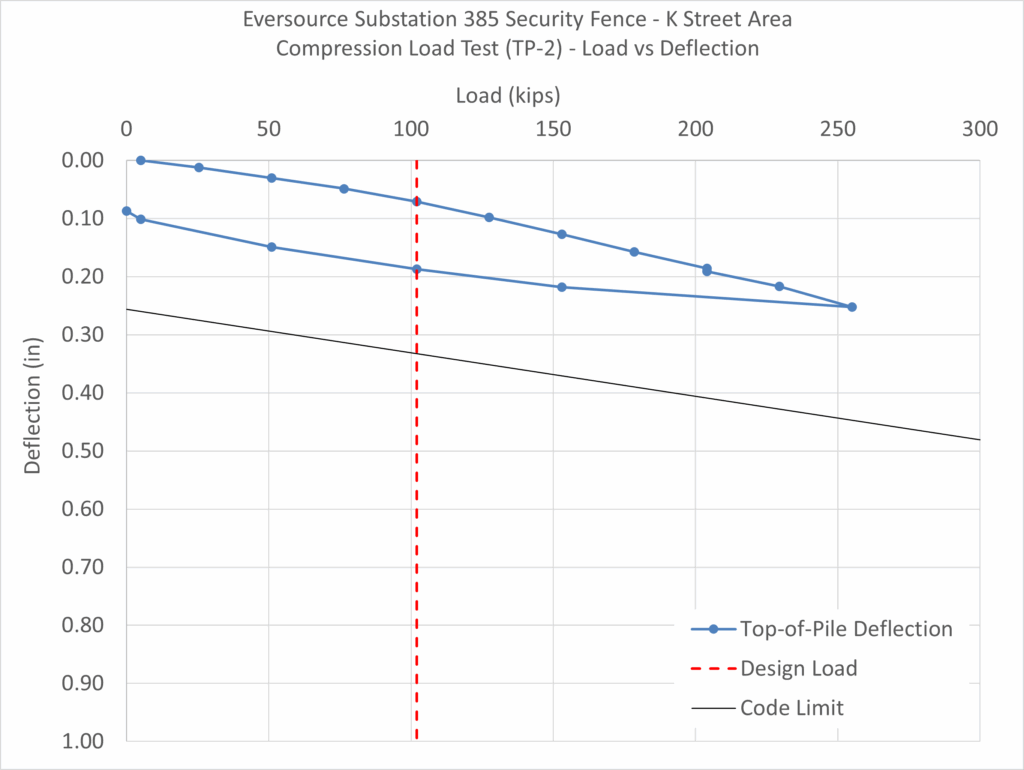
An extensive load test program for both DIPs and micropiles was undertaken at multiple locations on the site to verify system performance wiith the highly varying site conditions. DIP testing featured full-scale compression, tension and lateral load tests.
In the southwest portion of the site, DIP test piles were installed through the fill thin clay layer, and terminated in the glacial till with pile lengths of 36 and 37 feet. Full-scale compression and tension load tests were performed to 200% of the design load, where sustained periods to monitor creep were held, followed by continued loading up to 250% and 350% for compression and tension loads, respectively. Deflections of 0.25 inches and 0.15 inches, respectively, were noted at the maximum test loads indicating acceptable performance.
In the northeast portion of the site, closest to the water, DIP test piles were installed through the fill, very soft clay and terminated approximately 15 feet into the glacial till with pile lengths of about 68 feet. A full-scale tension load test was again performed to 200% of the design load with continued loading to 350% of the design following a creep hold period. A deflection of 0.17 inches was noted at the maximum test loads indicating acceptable performance. Lateral testing was also performed in this area by installing a group of three piles (one test pile and two reaction piles). The lateral test pile was loaded up to 200%, unloaded and then reloaded up to 250% of the design load (47.5 kips) before stopping the test with less than 0.5 inches of deflection.

After completing a successful test program for both DIPs and micropiles, Phoenix Foundation Company began installing piles. Work proceeded in phases around the site depending on staging and sequencing requirements of the general contractor (McCourt Construction). Ductile Iron Pile installations were accomplished across many areas of the site. As work proceeded towards the water, pile selection switched to micropiles as required to drill through buried granite blocks and other obstructions and to work in very limited access areas. Overall, a total of 326 Ductile Iron Piles and 375 drilled micropiles were installed across the site. DIP lengths were highly variable due to ground conditions and ranged from as short as 42 feet and up to 120 feet in the deepest zones of marine clay. An average depth of installation was 75 feet. Many piles encountered shallow till zones and terminated by achieving “set” on rock. The project represented an innovative approach to utilize a hybrid piling solution to provide the most cost-effective and fast solution through challenging ground and working conditions.
Project Team Members
Owner: Eversource, Inc.
DIP Installer: Phoenix Foundation Company, Inc.
Geotechnical Engineer: Haley & Aldrich, Inc.
Structural Engineer: Thornton Thomasetti
General Contractor: McCourt Construction Company