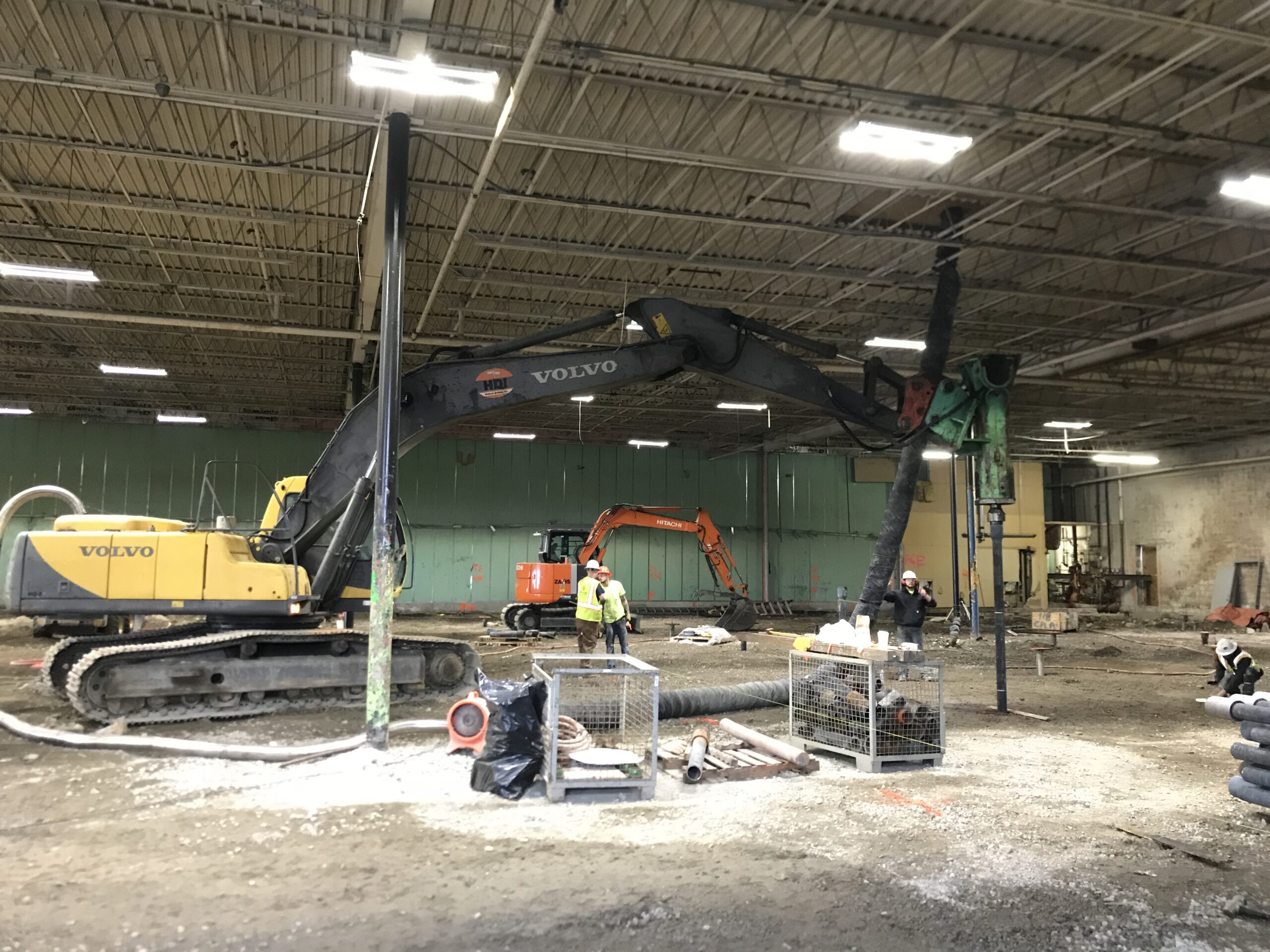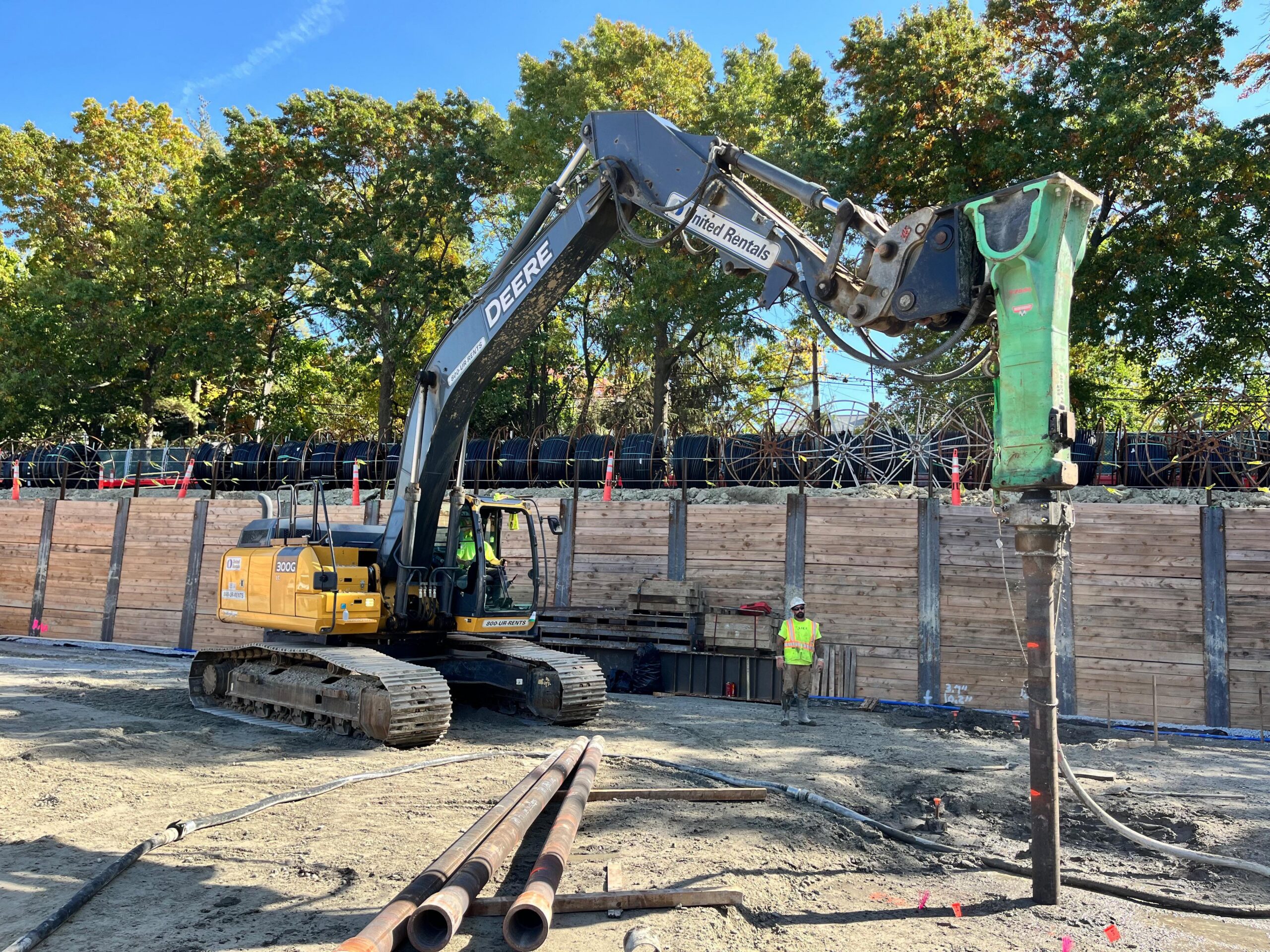

Ductile Iron Piles provided a low vibration, cost-effective foundation solution to support compression and tension loads on a constrained site.
Project Description:
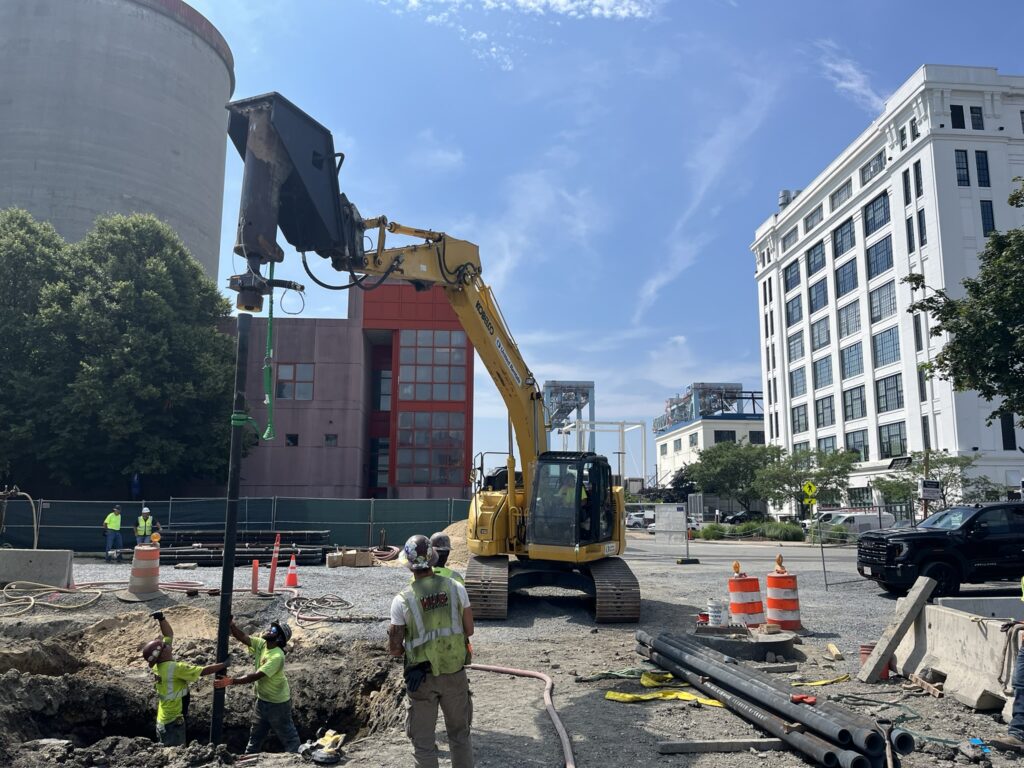
With the significant redevelopment of Boston’s Seaport, a new 2-story EMS station was planned at the end of Drydock Avenue near the Black Falcon Terminal to better serve this area. The 3,400 sq ft facility will house two EMS vehicles along with meeting space, employee living space and housing storage. Column loads for the site were up to 400 kips and some foundations required piles be designed for tension resistance.
Geotechnical Conditions:
Soil conditions consisted of deep fill extending to a depth of 26 feet followed by 9 feet of peat and organics soils as well as very stiff marine clay to a depth of 40 feet. Glacial till consisting of medium stiff clay and dense silty sand extended between 40 and 48 feet at which point rock was encountered. The rock was drilled to a depth of 53.5 ft at which point roller bit refusal was observed. Groundwater was tidal influenced and was generally around 20 to 30 feet below grade.
Project Challenges:
Provide a low vibration, cost-effective foundation solution to support compression and tension loads on a constrained site.
Advantages
- Low vibrations
- Medium-duty excavators to work on constrained sites
- Modular system to minimize space for laydown
- Versatile installations for both compression and tension efficiency
Design and Construction Solution
After consideration of various foundation options, the geotechnical engineer recommended Ductile Iron Piles to support both compression and tension loads. Plans specified Ductile Iron Piles with an allowable capacity of 100 kips (compression) and 15 kips (tension).
The design of the DIPs featured installation approaches using both dry and wet methods. All piles subject to only compression loads were designed with Series 118/9.0 Ductile Iron Piles driven with a heavy-duty drive shoe. The dry piles were planned to be driven to achieve set on rock. Pile locations that were subject to both compression and tension loads were designed as exterior grouted piles using the Series 118/9.0 pile with a 270 mm conical grout shoe to construct a ~10.5-inch diameter grouted displacement pile. The piles would also be driven to set, but needed to develop greater friction capacity in the glacial till to resist tension demands. The exterior grouted piles included a #8 (Gr 75) threadbar to resist the tension demands.
Prior to DIP installation, HUB Foundation performed pre-drilling at pile locations to reduce the risk of encountering obstructions from sea walls, buried timber piles and other debris. The predrilled holes were then backfilled with sand. HUB then installed 34 DIPs using the dry method and 8 DIPs using the wet method. Piles advanced easily through fill, organics, clay and till to terminate upon reaching set on the rock. Pile lengths generally ranged from about 40 to 50 feet below working grade. All piles were installed on the tight site within 3 days of production.
Project Team Members
DIP Design/Build Installer: HUB Foundation
Geotechnical Engineer: Haley & Aldrich, Inc.
General Contractor: J & J Contractors, Inc.
Structural Engineer: RSE Associates, Inc.
Owner: City of Boston