
Ductile Iron Piles – The Low Vibration Driven Pile
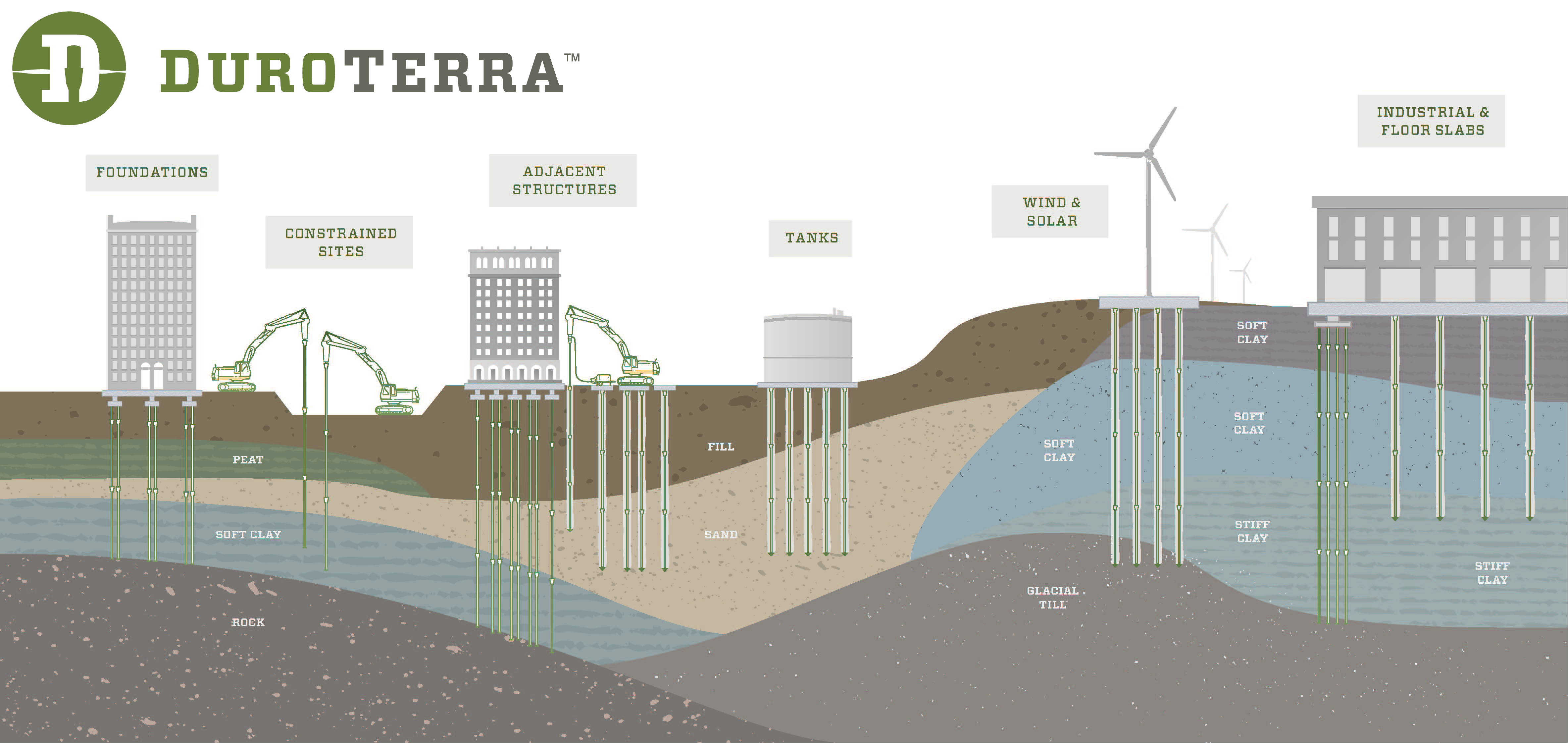
Ductile Iron Piles – the low vibration, driven pile system is a bit of a paradox in the driven pile world, where traditional driven piles are often associated with high vibration levels. Ductile Iron Piles provide many of the benefits of a traditional driven pile including speed, cost-savings and reliability while also offering low vibration installations.
How is that possible? Ductile Iron Piles are installed with an excavator-mounted hydraulic breaker hammer (i.e. demolition hammer) that delivers direct percussion energy to the pile head. While the energy per blow is much lower than a traditional diesel hammer, the hammer strikes at a much higher frequency to deliver the driving energy. The typical impact frequency ranges from 300 to 600 blows per minute – that’s 5 to 10 blows per second! But unlike a vibratory hammer used for some pile installations, this energy remains direct percussion or driving energy. The combination of the lower energy/blow and the higher-frequency impact results in a system that rapidly drives the pile with minimal vibrations.

Substantial vibration data has been collected at various project sites to verify acceptable levels, providing project teams with information to assess the feasibility of using a Ductile Iron Pile solution. These data are summarized in the Tech Brief on Ductile Iron Pile Vibration and Sound. As shown, the measured peak particle velocities (PPV) are typically between 0.25 ips and 1.0 ips at distances of only a few feet from installation.
 The low vibration levels combined with the ability to install Ductile Iron Piles in limited overhead areas or on constrained sites adjacent to existing buildings have made DIPs a preferred option on many projects. The system is frequently used as a more rapid and cost-effective alternative to drilled micropiles. DIPs also reduce the installation and performance risk associated with helical piles.
Check out a couple of the projects where minimizing vibrations contributed to the successful incorporation of Ductile Iron Piles. Looking for a cost-effective, low vibration option on your project, reach out for a feasibility assessment by one of our in-house engineers.
PROJECT EXPERIENCE – LITTLE ROCK AIRPORT CURBSIDE CANOPY

Construction involved a new departure gate curbside canopy at the Clinton National Airport. The new canopy was nearly 300 ft long with a 20 to 25 foot overhead cantilever on both sides. Supported on isolated column foundations subjected to both compression and overturning moments, the new canopy was planned near the existing canopy and terminal which presented both overhead access and vibration challenges. Ductile Iron Piles were specified for foundation support with piles penetrating existing fill and developing capacity in the underlying clay and sand. Exterior grouted Ductile Iron Piles using Series 118/7.5 material installed with a 220 mm grout shoe developed capacities of 46 kips (compression) and 30 kips (tension). Piles were installed with a Volvo EC290 excavator and Okada TOP270 percussion hammer. The solution provided a low vibration foundation support that could easily access the constrained site with limited overhead areas. For more information, check out the project summary.
PROJECT EXPERIENCE – 230 FRIEND STREET
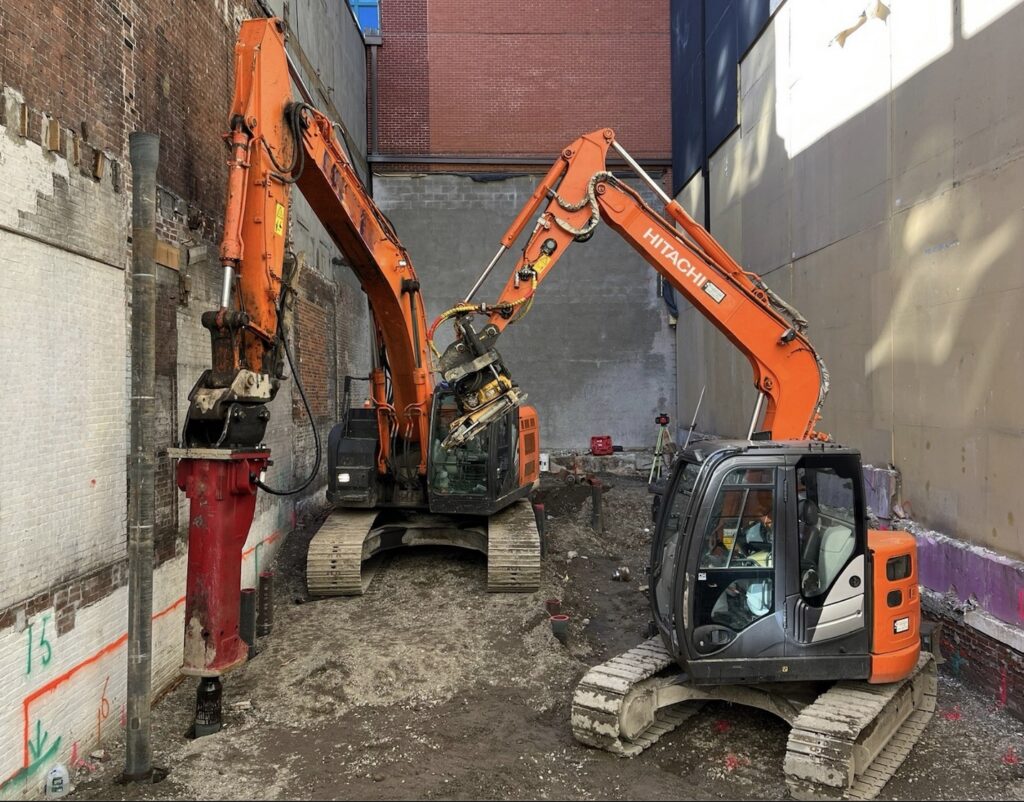
The site of a new 7-story, condominium building near Boston’s T.D. Garden was planned on a 2,050 sq ft lot between an existing aging brick building and new 7-story apartment building previously supported on Ductile Iron Piles. New foundations for the building positioned on the 27-ft wide lot included pile caps and grade beams with up to 200 kip compression loads and 90 kips of tension loads. A Ductile Iron Pile solution was specified to transfer loads through the 13 feet of urban fill, 17 feet of organics followed by soft marine clay to glacial till and weathered Cambridge Argillite at depths around 75 feet. A Series 170/9.0 pile was used to provide capacities of 50 tons (compression) and up to 5 kips (lateral). In locations requiring tension resistance, an exterior grouted pile installed with a 270 mm grout shoe was installed to resist up to 30 kips of tension. A total of 33 piles were installed to depths ranging from 63 to 89 feet in 4 days with minimal vibration levels. For more information, check out the project summary.