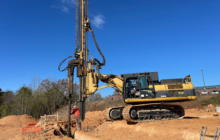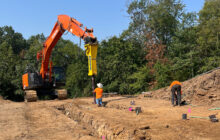

Ductile Iron Piles provided a deep foundation solution, developing capacity through end-bearing on rock at variable depths while remaining well-suited for the small site footprint.
Project Description:
The project consisted of construction of a three-story multifamily residential structure with a building footprint of around 6,000 square feet. The site was located in a remote area with mountainous terrain.
Geotechnical Conditions:
Soil conditions consist of an upper stratum of very soft to stiff lean clay (CL) and silt (ML), which was encountered to depths of 35 to 45 feet in the borings. Weight of sampler soils were encountered from the ground surface to a depth of 35 feet in one boring. Underlying the cohesive soils, soils consisted of medium dense to dense sandy or silty gravel (GP, GM), silty sands (SM) and sands (SP) until auger refusal. Borings refused on sandstone (Culter formation), which was encountered at depths ranging from 49 to 79 feet in the borings. Groundwater was encountered in the borings at depths ranging from 3 to 5 feet.
Project Challenges:
Provide a deep foundation solution developing capacity in end-bearing on rock at variable depths while easily working on the small site footprint.
Advantages
- Easy site access in constrained working areas
- Robust piles developing end-bearing on bedrock at variable elevations
Design and Construction Solution
The three-story building was originally designed to be supported by a series of pile caps and grade beams bearing on driven steel H-piles terminating on rock. The HP-12×53 sections were designed for a maximum compression loading of 70 kips. While rock depths varied, an average pile length of 60 ft was expected.
While the driven H-pile system was adequate for supporting the structural loads of the new building, the small footprint work area on the site of mountainous terrain made site access for traditional pile driving equipment challenging. In addition, laydown room on the tight site presented issues for the long piles. The variability in bedrock would also likely result in the need for pile splicing, which was expected to be costly and slow.
Keller-NA considered a driven Ductile Iron Pile (DIP) alternative, which could be installed with smaller equipment that was more suitable for the constrained work area, while still delivering a robust deep foundation solution. In addition, the Plug and Drive connection for the DIPs easily accommodated the variability in the rock depth without any need for field splicing – saving both time and money. Keller-NA worked with engineers at DuroTerra to develop this alternative approach.
Keller-NA decided on a design solution using non-grouted (exterior) Series 118/9.0 (118 mm O.D. and 9 mm wall thickness) DIPs, installed with 118 mm HD driving shoes. Preliminary evaluations suggested that DIPs would develop the required demand of 70 kips by achieving “set” (1” penetration in 50 seconds) on the sandstone bedrock encountered in the borings.
The Ductile Iron Pile design capacity was verified by load testing to 140 kips, twice the design load. Keller used a Link-Belt 250 X4 excavator equipped with an Epiroc HB2500 percussion hammer to install the DIPs. A total of 44 DIPs were installed in only a few days in snowy & wet conditions at the site.
Project Team Members
DIP Design/Build Installer: Keller-NA
Geotechnical Engineer: Trautner Geotechnical, LLC
Structural Engineer: Goff Engineering & Surveying
General Contractor: Shaw Construction