
What Equipment is Needed to Install Ductile Iron Piles?
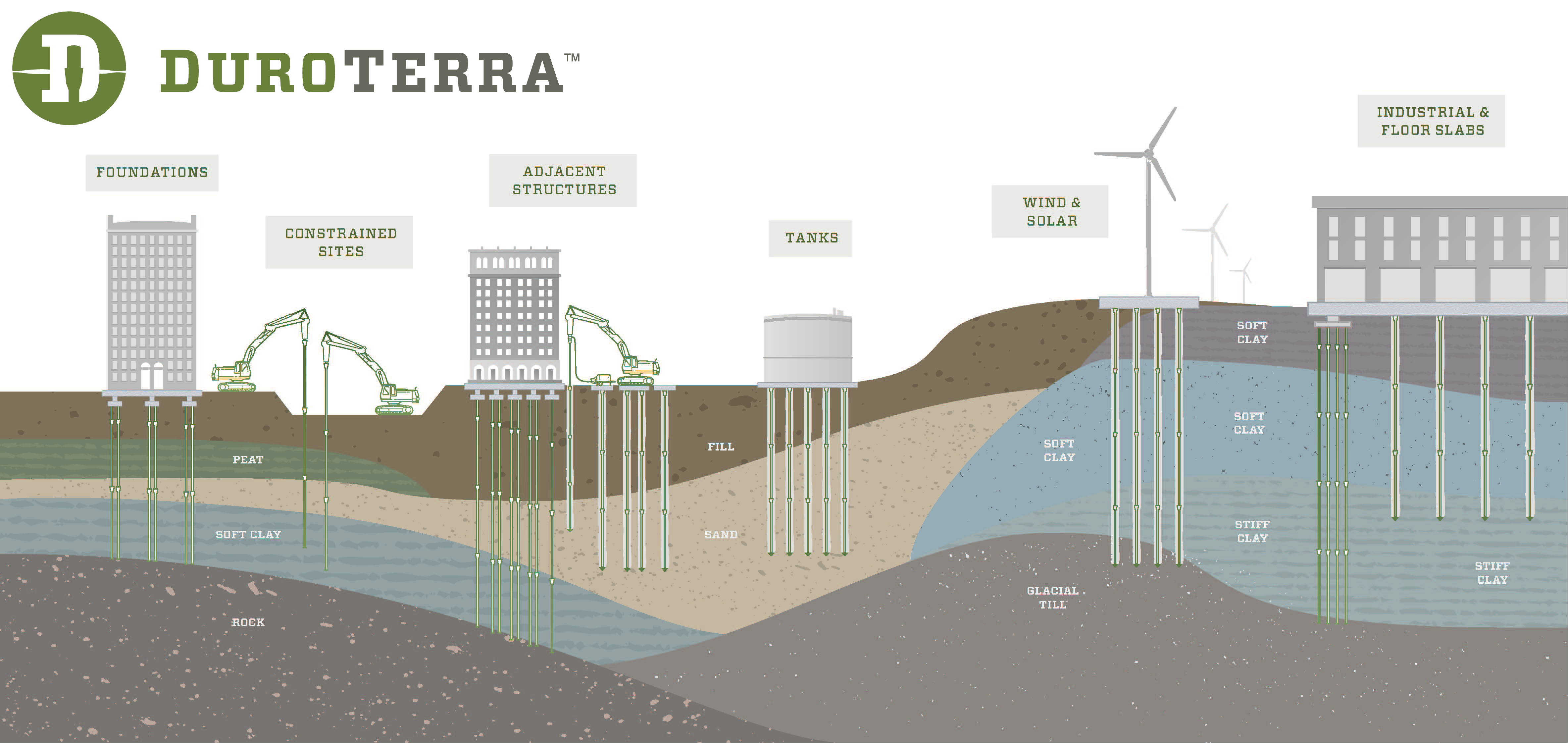
DuroTerra continues to work with an increasing number of geotechnical contractors around the U.S. and Canada. “What equipment do we need to get started?” is a common question asked by our new installers.
Unlike many other foundation systems that require expensive, purpose-built specialty machines, Ductile Iron Piles (DIPs) have been installed for more than 40 years using standard conventional earthwork equipment. In fact, this is one of the most attractive features of the TRM Ductile Iron Pile system. This type of equipment is often in a contractor’s fleet, easily available from a rental company or is relatively inexpensive and available for immediate purchase. The installation equipment includes: a medium-duty excavator, hydraulic percussion hammer, drive tool (shank), and grout/concrete pump. The amount of specialized equipment and tooling is limited to only the drive tool.
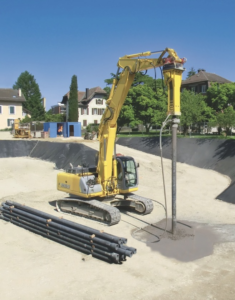 Base tracked excavators used for Ductile Iron Piles are typically in the 20 to 35 ton service or operating weight range. Alternatively, vertical-mast equipment with a hydraulic hammer have been used on occasion. One primary factor for excavator selection is the need to supply the required hydraulic flow / power to the hammer. Compatibility of the excavator with the hydraulic hammer is extremely important to both equipment performance and pile installation. Secondly, selecting an excavator with sufficient reach (height) to easily allow driving on the top of the 5-meter pile sections is also important. Experienced installers often customize side-mount hammer brackets to reduce height requirements.
While hydraulic percussion hammers are common and easy to obtain, selecting the proper size is a critical part of the Ductile Iron Pile installation process. Selection of the hammer is critical to ensure 1) adequate hammer energy to drive the piles to depth and/or to obtain proper “set” conditions and 2) excessive hammer energy is avoided for concern of overstressing and damaging the pile during driving. Typical hammer energy ranges from 3,000 ft-lb up to 7,000 ft-lb depending on pile size and driving conditions. Common hammers used by installers range from Epiroc (Atlas Copco) MB1650 (EC140T) up to HB2500 (EC155T) and Tramac V1800. Hammers in the lower range are well-suited to drive Series 118 piles, while the upper range are suited for Series 170 piles. Many contractors select HB2500 or V1800 which are well-suited to drive both the Series 118 and Series 170 pile sections. Other, hammers can also be used and DuroTerra should be consulted to assist with hammer size selection to make sure that the proper hammer and drive shank are used for your application.
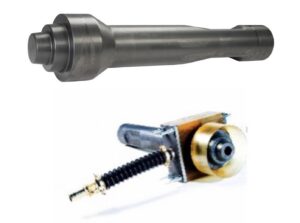
Specialty tooling (drive shanks) is required for installation of the Ductile Iron Piles. A dry (solid) solid drive shank is used for dry or non-grouted (exterior) installations commonly for end-bearing applications. A wet or grout shank, along with a grout box, is used for exterior grouted installations, typically for friction applications. Drive shanks are the only specialty tool required for Ductile Iron Pile installations. Driving shank dimensions are specific to hydraulic hammers and tooling needs to be properly matched with the hammer. DuroTerra maintains an inventory of dry and wet shanks for some commonly used hydraulic hammers. In the event tooling is not available, custom manufacturing can be provided for nearly any hydraulic hammer.
Widely available concrete or grout pumps are required for installation of exterior-grouted Ductile Iron Piles and also during the dry-installation method to fill the interior of the pile with grout. Like hammer selection, it is important that the grout pump be selected so that it is not too small (insufficient pressure) to introduce grout at depth in the pile, nor is it too large, causing excess pressure resulting in blockages in the line. For delivering sanded grout often used for exterior grouted piles, swing-tube pumps are most common. Pumps with ¼- to ½-cubic foot/stroke operating in the range of 30 to 50 CY/hour are recommended. For mixing neat cement grout, typical high-shear colloidal mixers (like for micropiles) are used.
If you are interested in learning more about the equipment requirements, contact us today. Want to see if the Fast, Simple, and Safe® Ductile Iron Pile system makes sense on your next deep foundation project? Our geotechnical engineers and construction personnel can help you evaluate applicability and feasibility with no up-front obligation.
PROJECT EXPERIENCE – GULF HIGH SCHOOL
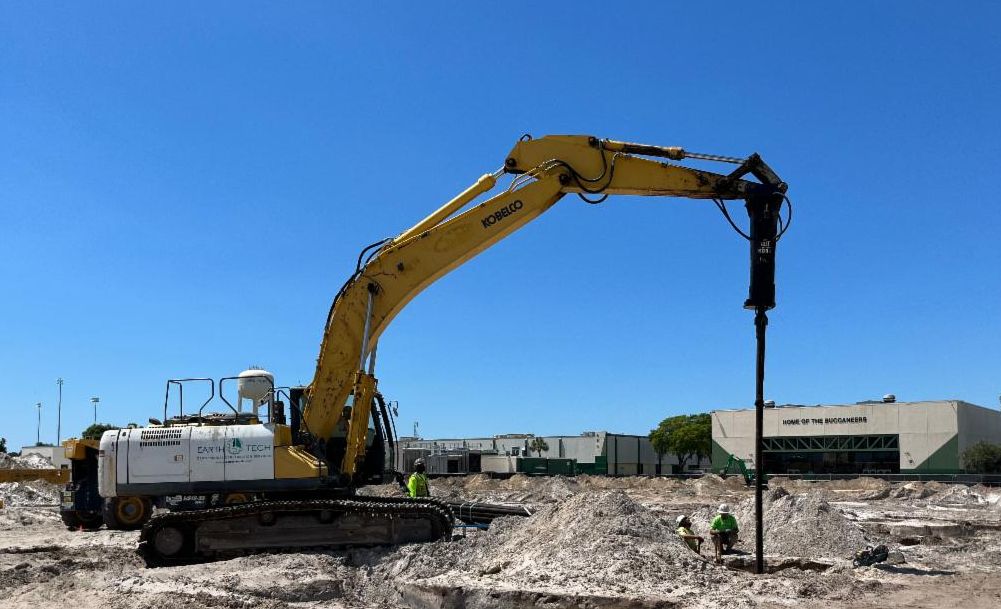
With a mix of loose to medium dense sand and soft to stiff clay extending to highly variable limestone bedrock, construction of the new Gulf High School addition required a versatile foundation solution. The new 2-story, 90,000 sqft building had column and wall loads up to 250 kips and 7 klf, respectively along with tension demands at specific locations. Soil borings showed limestone bedrock varied in depth ranging from 22 to 37 feet and was also highly variable in the degree of weathering.
With a tight construction schedule and sensitivity to costs, the design team explored a variety of common foundation options and ultimately selected Ductile Iron Piles. One major advantage of the Ductile Iron Pile system is the ability to easily adjust pile lengths using the Plug and Drive connection system to handle highly variable rock depths without delays.
The project was specified for Ductile Iron Piles with capacities of 50 kips in compression and 5 kips of tension and lateral. MENARD designed a Series 118/7.5 Ductile Iron Pile (118 mm OD with 7.5 mm wall thickness) to provide the required capacities. Full-scale compression, tension and lateral tests confirmed the design approach. Following testing, MENARD installed over 850 Ductile Iron Piles using an CAT H130 hammer. Pile lengths ranged from 10 feet to as much as 90 feet (with an average of about 32 feet) as a result of the highly variable limestone. Soils were so soft in locations that many piles advanced under the crowd of the excavator prior to driving into the rock. The resulting production was over 900 linear feet/crew day, which kept the project on the tight schedule. For more information, check out the project summary.
PROJECT EXPERIENCE – NETFLIX STUDIOS

Plans for a new 161,000 sqft movie studio required foundation and retaining wall support abutting an existing, vibration-sensitive retaining wall on a portion of the site. While ground improvement was planned for the majority of the project, Ductile Iron Piles were selected to limit vibration concerns in the critical areas. The design required exterior grouted Ductile Iron Piles to be installed through the fill and organic clay to develop working capacities of 40 tons (compression) and 19 tons (tension) through friction in the underlying medium dense to dense sand. Following successful load testing, ICOP (formerly GeoStructures, Inc.) installed a total of 195 piles in 11 working days with no impacts to the retaining wall. Installations were completed with an Atlas Copco HB2000 hammer. For more information, check out the project summary.