
Regional Spotlight – Geotechnical Challenges in America’s Heartland
With our next industry event bringing us to Madison, Wisconsin for DFI’s S3 conference from August 5 to 7, there’s no better time to recognize the geotechnical conditions that characterize America’s Heartland – the Midwest Region of the U.S – and pose challenges on many projects. The “Midwest” spans across the north central United States from Ohio westward to the Dakotas and stretches from Kansas north to the Canadian border.
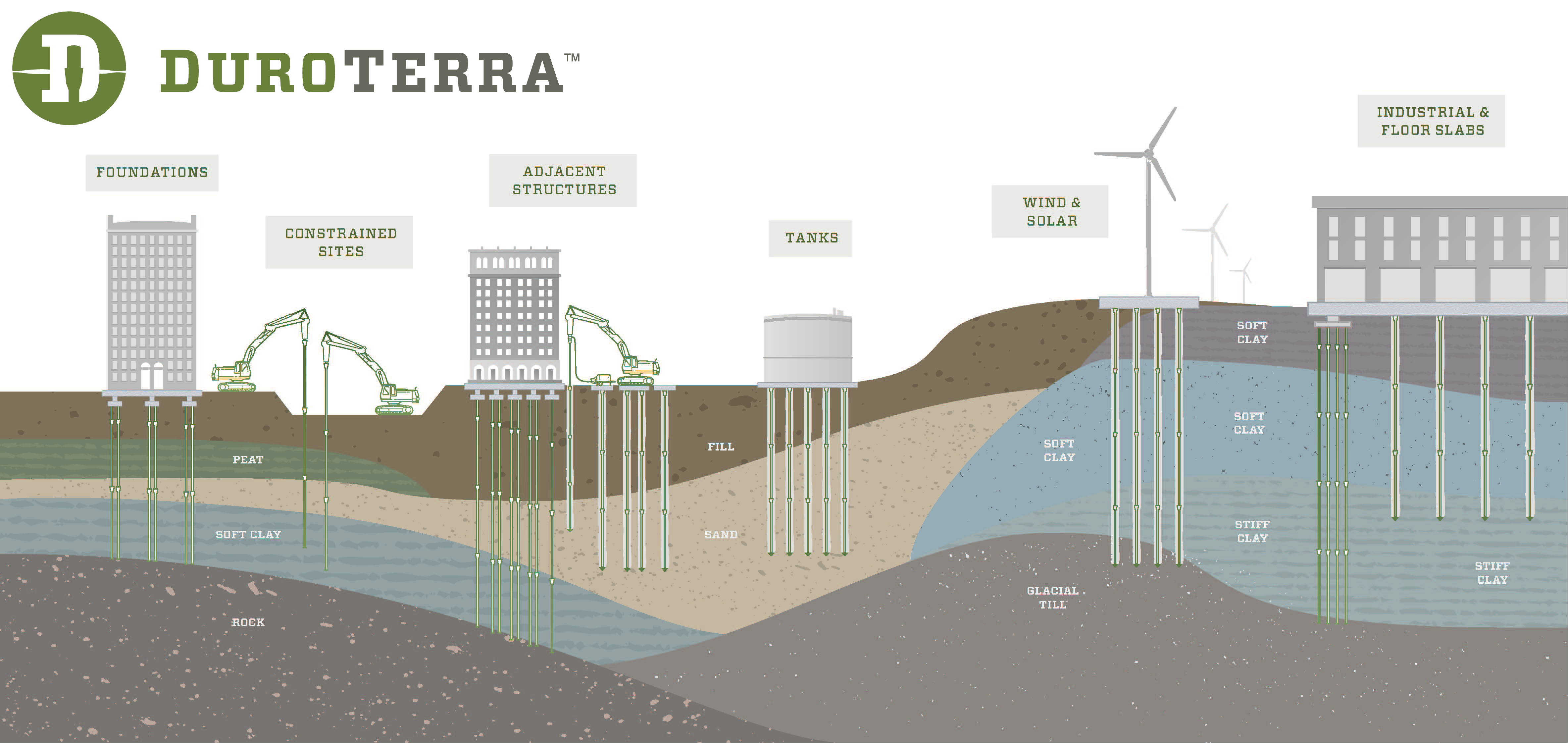
With major rivers including the mighty Mississippi River, the Missouri River, and the Ohio River, and all of the lesser tributaries running through this region, it’s no wonder that many of the geotechnical conditions originate from alluvial deposits. These deposits are often highly variable and compressible and can extend to considerable depths in some locations. This often drives foundation solutions towards deep foundations. Given the wide-open expanses of the northern plains, loessial or wind-blown deposits of silt are also common in places like Illinois, Iowa, Nebraska and Missouri. These soils are also soft and compressible and can be collapse-prone when subjected to water. But water and wind aren’t the only natural elements at work in the Midwest. Much of the area was subject to glaciation during the last Ice Age. The glaciation process provided high consolidation pressures that overconsolidated soils in many regions. During the glacial melting, glacial outwash deposits of sand and gravels were common in glacial river valleys. Lastly, whether attributed to alluvial deposits or the glaciation process, peat and organic soils are prevalent throughout this area. These unsuitable conditions are highly compressible and often result in substantial settlement of buildings, roads, or other projects when left untreated – making deep foundation solutions.
With all of these problematic ground conditions, DuroTerra is helping project teams solve geotechnical challenges with Ductile Iron Pile solutions and has been for over a decade. Whether its piles driven to end-bearing on limestone or shale bedrock common in the region or exterior grouted displacement friction-piles to bypass compressible alluvial or organic deposits, Ductile Iron Piles have a proven and reliable solution for Midwest geotechnical conditions.
In this month’s DuroTerra Dialogue, we’re featuring a few projects throughout the Midwest region that highlight many of the geotechnical conditions noted as well as the versatile conditions where the system shines. Have a project in the Midwest (or beyond) that may be a candidate for DIPs? Please reach out to us for a feasibility assessment to see if DIPs is a good fit!
PROJECT EXPERIENCE – NORFOLK SOUTHERN MILL SHOP

The addition of a new crane system within the existing Norfolk-Southern Mill required 25-ton piles to support the new foundations. With 20 feet of overhead clearance combined with challenging fill conditions, the project was originally specified for drilled micropiles. A value engineered alternative consisting of Ductile Iron Piles replacing the micropiles on a 1:1 basis was selected based on speed and cost. The grouted displacement piles were installed to penetrate the fill and soft to stiff silt and clay to develop grout-to-ground bonding capacity in medium dense sand below. A total of 48 piles were installed in only 3 days. For more information, check out the project summary.
PROJECT EXPERIENCE – UNITED FIRE GROUP ADDITION
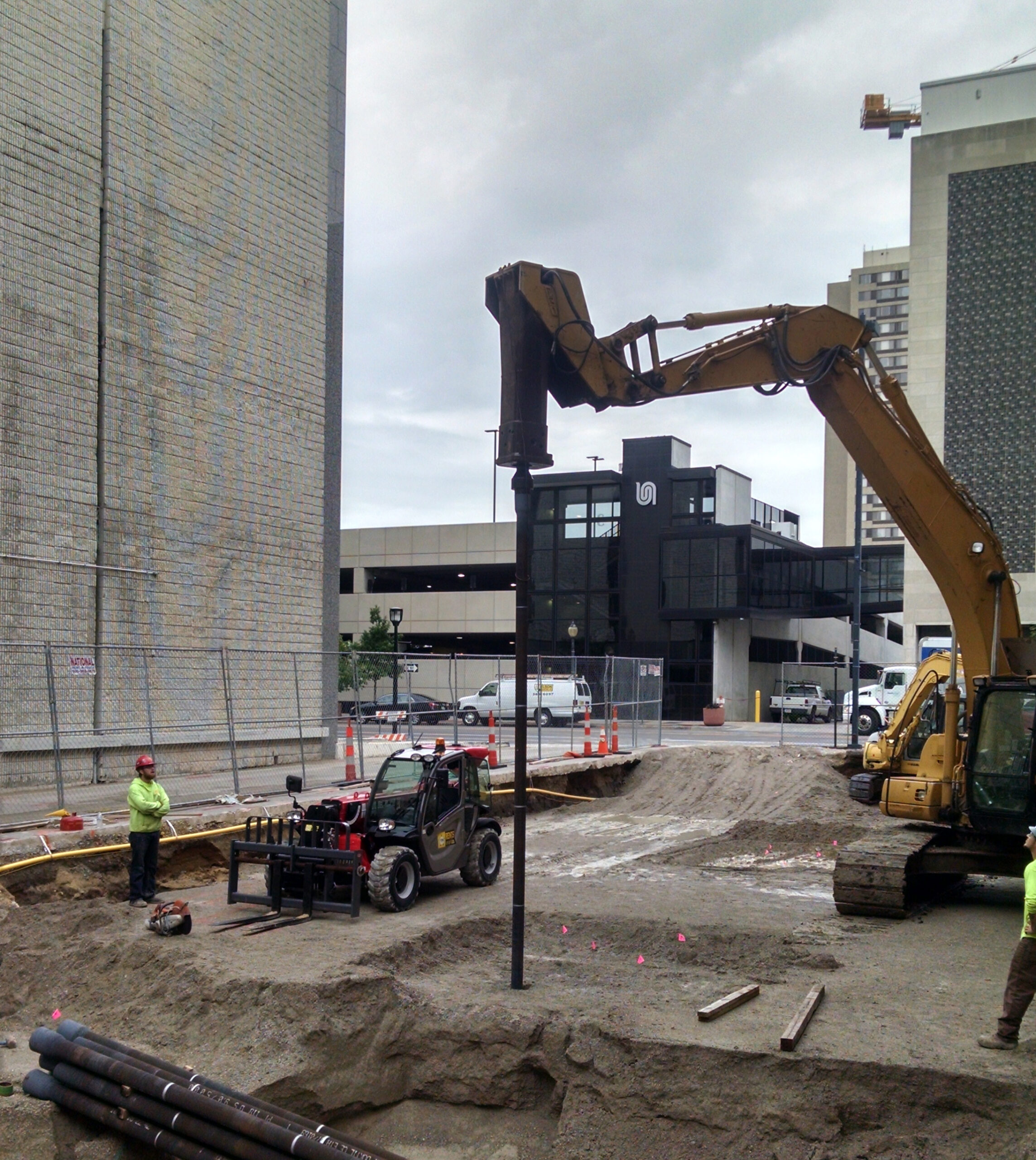
United Fire Group (UFG) planned construction of a 4-story building addition between two existing buildings on a 4,800 square foot footprint in downtown Cedar Rapids, Iowa. Column loads were up to 700 kips. Soil conditions consisted of up to 18 feet of variable fill underlain by sand to depths of 17 to 20 feet followed by stiff to very stiff glacial clay. Limestone bedrock was encountered at depths of 66 to 85 feet below grade. Designers originally considered auger-cast piles and drilled shafts to navigate the challenges of the urban, limited access site with deep bedrock. Instead, a Ductile Iron Pile VE alternative was selected based on the cost, low vibrations, and ease of installation on the tight site.
DIP designers selected a Series 118/9.0 piles to provide a 50 ton compression capacity by terminating on limestone. A total of 63 piles were required to support building loads. Pre-production load testing was performed by Peterson Contractors, Inc. on a pile terminating on rock at a depth of 72 feet. Top-of-pile deflections of 0.32 inches and 0.89 inches were recorded at loads of 50 tons (100% design load) and 100 tons (200% design load), respectively. The pile rebounded to a net deflection of only 0.4 inches, indicating acceptable load test performance. Following excavation of the pile caps, the production piles were installed to rock and terminated upon reaching the set observed in the load test. For more information, check out the project summary.
PROJECT EXPERIENCE – JACOBSON PLAZA AT FALLS PARK

Construction of a new $18.5M, 14,000 square foot recreation facility was planned on a major Brownfield site that previously operated as a railyard maintenance facility and scrap metal salvage yard. Ground conditions consisted of highly-variable, debris fill extending to depths ranging from 7 and 14 feet. The fill was underlain by topsoil followed by Sioux Quartzite bedrock. With concerns over contaminated spoil removal from ground improvement and issues with helical piles penetrating the fill and spinning out on rock, Ductile Iron Piles were specified for the project. Late fall construction required rapid installation to stay ahead of winter conditions in the upper Midwest. On the first day, Deep Foundation Group (DFG) installed a test pile to 13 feet to rock. The load test was set up and performed immediately. Test results showed only 0.20 inches of movement at 90 kips (200% design load). DFG continued with production work and installed a total of 114 piles to depths up to 25 feet in only 2 days, averaging over 1,000 LF/day. All pile work, including interior grouting and load testing, was completed in only 3 days total to help the project stay ahead of winter weather. For more information, check out the project summary.